Perseid meteor shower: How to watch spectacular sky show in Kenya on August 13
By Valerian Khakayi, August 13, 2026Skywatchers in Kenya have a chance to witness one of the year’s most spectacular celestial displays as the Perseid meteor shower reaches its peak in the early hours of Thursday, August 13, 2026.
The Kenya Space Agency (KSA) has encouraged Kenyans to look to the skies, noting that the meteor shower offers an opportunity to see bright meteors streak across the night sky.
“Get ready for one of the year’s most spectacular meteor showers! The Perseid Meteor Shower peaks on the night of 12–13 August 2026, offering skywatchers a chance to see bright meteors streak across the night sky,” KSA said.
The agency advised skywatchers to find a dark location away from city lights and look up.
“How to watch: Find a dark location away from city lights and look up,” KSA added.
What are the Perseid meteor showers?
The Perseids are an annual meteor shower that occurs when Earth passes through a trail of dust and debris left behind by Comet 109P/Swift-Tuttle as it travels around the Sun.
According to NASA Science, as Earth moves through this debris stream, tiny particles enter the planet’s atmosphere at very high speeds. The friction and compression of the air cause them to heat up and glow, producing the brief streaks of light commonly known as “shooting stars.” They are not actually stars falling from the sky.
The meteors appear to come from the direction of the constellation Perseus, which is why the shower is known as the Perseids. Additionally, the shower is active from July into August, with the strongest activity occurring around its peak. In 2026, the peak falls overnight from August 12 into August 13.
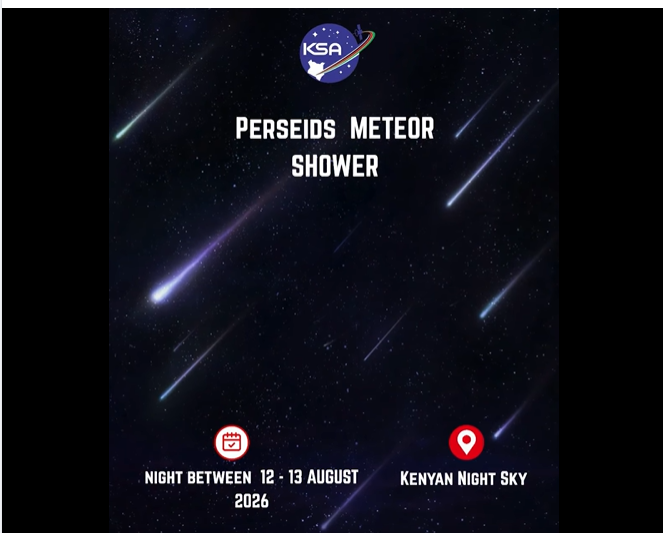
How to watch the Perseids in Kenya
For Kenyans hoping to catch the display, the best approach is to move away from brightly lit urban areas and find a location with a clear, unobstructed view of the sky.
Skywatchers should ideally begin watching after midnight and continue into the early morning hours, when meteor activity is generally more favourable. The meteors can be viewed with the naked eye, meaning there is no need for a telescope or special equipment.
Allow your eyes about 20 to 30 minutes to adjust to the darkness and avoid looking at bright phone screens while waiting for the meteors.
The 2026 Perseids are expected to benefit from particularly dark skies because the peak coincides with a new moon, meaning there will be little or no moonlight to wash out the fainter meteors.
However, the number of meteors seen will depend on location, weather conditions and light pollution. For the best experience, choose a clear night, lie back and scan a wide section of the sky rather than focusing on one particular spot.
The Perseids can remain active after the peak, although the number of visible meteors gradually decreases as the shower moves away from its maximum.