Why KRA’s plan to file returns for non-compliant taxpayers is bad news
By William Muthama, June 9, 2026If you have not filed your 2025 income tax return yet, Tuesday, June 30, 2026, is a date you should not ignore.
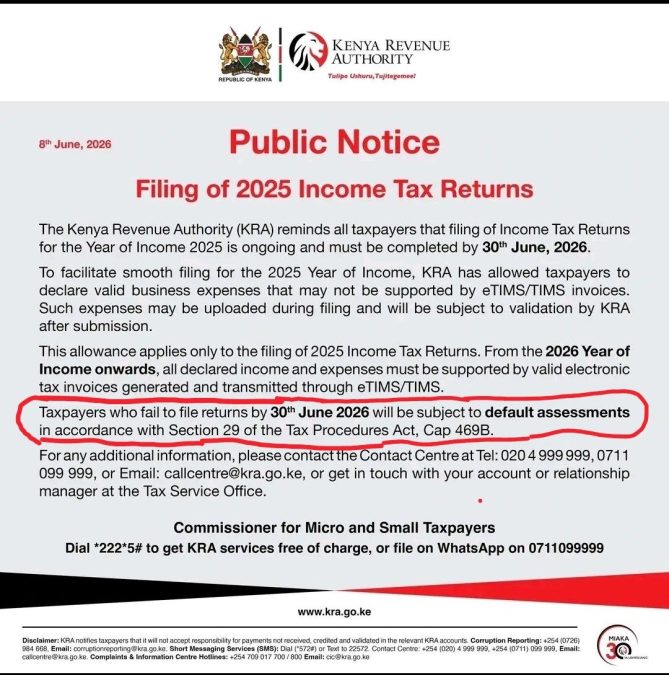
In a public notice, on Monday, June 8, 2026, the Kenya Revenue Authority (KRA) warned that taxpayers who fail to submit returns by the June 30 deadline will be subject to default assessments under Section 29 of the Tax Procedures Act.
“Taxpayers who fail to file returns by 30th June 2026 will be subject to default assessments in accordance with Section 29 of the Tax Procedures Act, Cap 469B,” the taxman said.
In simple terms, this means the tax authority can determine your tax liability using information already available in its records if you do not file your return yourself.
KRA will calculate it
Normally, taxpayers file their own returns, declare their income, list their expenses, and claim any tax reliefs they qualify for.
However, if you fail to submit your return by the deadline, KRA can use information already available to estimate how much tax you owe.
This information may include PAYE records, withholding tax certificates, bank transactions, mobile money records, supplier payments, and other third-party data available to the authority.
KRA will then create a tax assessment based on what it believes is your income and tax liability.
You lose control
The biggest problem with a default assessment is that you lose the opportunity to tell your side of the story.
For example, KRA may not know about legitimate business expenses, losses, deductions, or tax reliefs that could significantly reduce your tax bill.
As a result, the amount assessed may be much higher than what you would have paid if you had filed your own return on time.
Once the assessment is issued, it becomes legally valid unless you successfully challenge it.
Burden shifts to you
After KRA issues a default assessment, the responsibility changes.
Instead of KRA proving that you owe the tax, you must provide documents and evidence showing why the assessment is incorrect.

This can involve filing objections, responding to audits, and providing financial records to support your case.
The process can be time-consuming and stressful, especially for businesses that have not maintained proper records.
Penalties keep growing
Missing the deadline can also trigger additional costs.
Individual taxpayers face a minimum late-filing penalty of Ksh2,000, while companies face a minimum penalty of Ksh20,000 or 5 per cent of the tax due, whichever is higher.
On top of that, unpaid taxes attract interest at a rate of 1 per cent every month.
If the matter remains unresolved, KRA can take enforcement action, including freezing bank accounts or attaching assets to recover the outstanding tax.
For taxpayers, the message is clear: filing your return before Tuesday, June 30, 2026 is far easier and cheaper than allowing KRA to estimate your tax bill on your behalf.