El Niño rains: Why people living in ground-floor houses should start getting worried
By Steve Ireri, August 27, 2026For tenants living on the ground floor of apartment blocks across Nairobi, the coming rainy season could bring a problem far more serious than wet clothes, muddy compounds and flooded roads.
As Kenya braces for an expected strong El Niño during the October–December 2026 short-rains season, people whose homes sit closest to the ground could find themselves among the first to feel the effects of intense rainfall.
The Kenya Meteorological Department (KMD) has warned that above-average rainfall is expected over about 80 per cent of the country during the October–December season, with prolonged wet spells and isolated storms expected in several areas. The department has also indicated an 81 per cent likelihood of a very strong El Niño and a 97 per cent chance that the phenomenon will persist into the early months of 2027.
That forecast does not mean every Nairobi neighbourhood will flood, or that every ground-floor tenant is automatically in danger. But it raises an important question for thousands of city residents: what happens when unusually heavy rain meets a house that sits at, or below, the level of the surrounding roads and drainage channels?
The ground floor problem
The danger is not simply that rain falls on the roof. For some buildings, the real vulnerability is at the bottom. When drainage systems become overwhelmed, blocked or unable to carry away stormwater quickly enough, water can accumulate in compounds, roads and open spaces before finding its way into buildings.
This is a problem Nairobi residents have experienced before. During heavy rains in January 2024, ground-floor tenants in parts of Embakasi found themselves battling floodwater inside their homes. At one apartment, a caretaker told Citizen Digital that water had entered ground-floor houses, forcing landlords to bring in pumps to remove it. One tenant in Kayole described waking up to a house flooded with a mixture of rainwater and sewage.
In Zimmerman, heavy rains similarly left entire ground floors flooded to knee level, while muddy water and debris from a burst sewer line spread around residential buildings. The experiences offer a glimpse of what can happen when heavy rainfall overwhelms drainage infrastructure.
And for a tenant living several metres above the ground, such water may remain a problem outside the building. For someone living on the ground floor, it can become a problem inside the house.
Your house could be lower than the road
One of the biggest warning signs is the relationship between the building and the surrounding road. Some apartment compounds are constructed at a lower elevation than neighbouring roads or drainage channels. When this happens, stormwater can naturally flow towards the compound instead of away from it.
One may remain relatively dry. The other may have tenants pushing furniture onto beds and tables as water begins entering their rooms.
Your door could become the entry point
Ground-floor tenants also have another vulnerability: doors and entrances that open directly onto compounds, parking areas or pathways. When water accumulates outside a building, even a relatively small difference in height between the outside surface and the inside floor can determine whether the water remains outside or crosses the threshold.
During previous Nairobi floods, residents have reported water entering homes after roads and compounds became inundated. Heavy rains have also repeatedly exposed the city’s drainage problems, with houses and businesses submerged in different parts of the capital.
For a tenant, that can quickly turn into a property-loss problem. A mattress lying on the floor can be ruined. sofa can absorb contaminated water. Clothes, books, documents and electronics kept near the floor can be destroyed within minutes. And once sewage mixes with floodwater, the problem is no longer simply about damaged belongings.
The sewage problem
One of the most unpleasant dangers associated with flooding is the possibility of sewage entering homes. Floodwater moving through an urban neighbourhood can pick up waste, mud, rubbish and other contaminants before reaching residential buildings.
This is precisely what one Kayole tenant encountered during the January 2024 floods, when water entering her ground-floor home was described as a mixture of rainwater and sewage. Such contamination makes cleaning considerably more difficult and can increase exposure to disease-causing organisms.
KMD and other authorities have repeatedly warned that flooding can increase the risk of waterborne diseases, particularly where sanitation systems are overwhelmed. For ground-floor residents, therefore, the concern is not simply “Will water enter my house?” It is also “What is in that water?”
Your belongings may be the first casualties
For many tenants, the biggest immediate loss may be their belongings. People living in small Nairobi apartments often have limited storage space, meaning household items are kept close to the floor.
A television may sit on a low stand. Shoes may be underneath a bed. Suitcases may be pushed into a corner. Clothes may be stored in boxes. Important documents may be kept in drawers only a few centimetres above the floor.
When floodwater enters, these are among the first things exposed. The 2024 floods demonstrated how quickly such losses can accumulate. The Kenya Meteorological Department’s State of the Climate report notes that heavy rainfall during the March–May 2024 season caused severe flooding in Nairobi, with informal settlements including Mathare, Kibera and Mukuru among the hardest-hit areas.
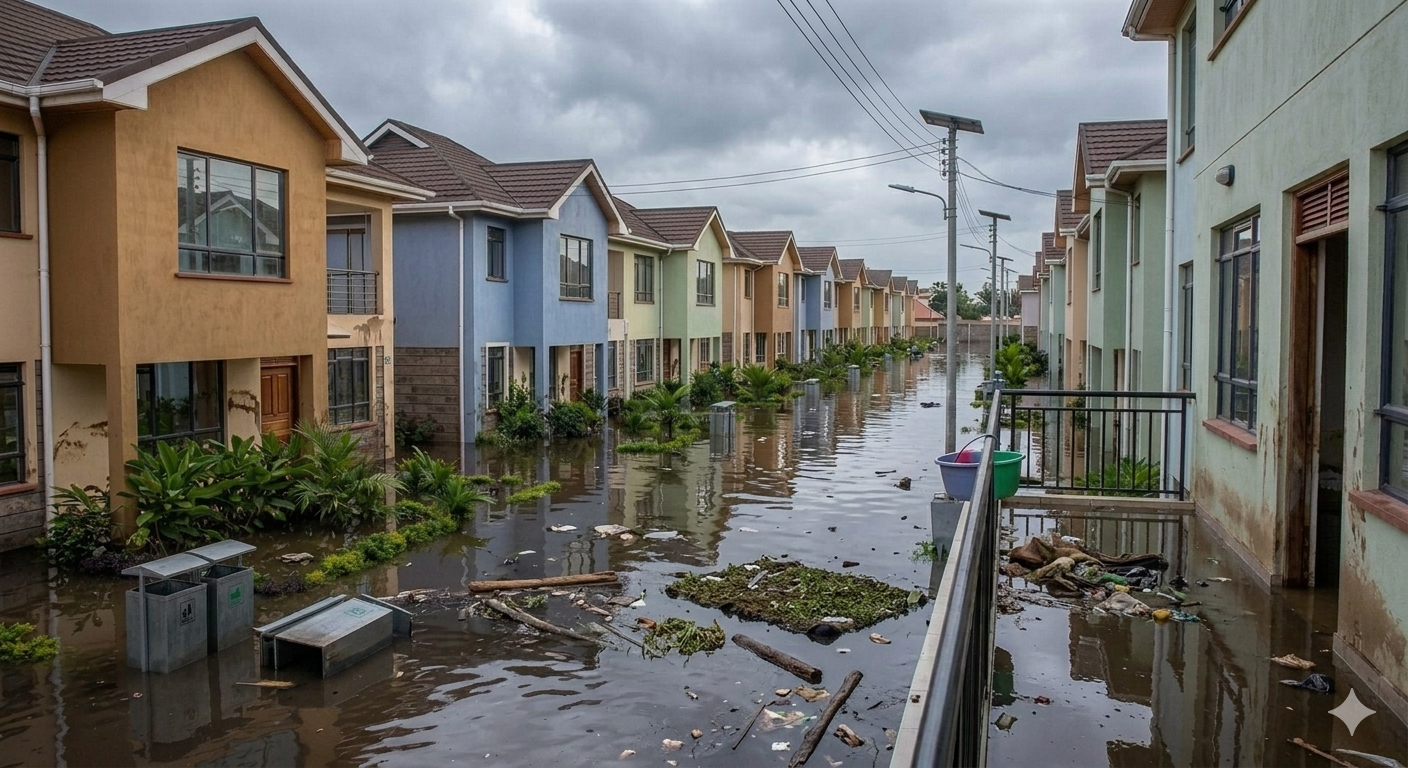
A national flood recovery assessment later estimated that more than 82,000 households were affected across the country during the 2024 floods, with more than 58,000 households displaced. Nairobi, Machakos and Kiambu were among the areas that experienced major infrastructure damage.
The coming El Niño season may, therefore, force tenants to think about flooding not merely as a traffic problem, but as a housing problem.
Even getting out could become difficult
There is another issue ground-floor residents should consider: access. If a compound floods, the entrance and exit may become difficult or dangerous to use. A tenant may technically be inside a building that is structurally safe but find that the only route to the road is covered by fast-moving or contaminated water.
This can become particularly concerning for households with children, elderly people or people with disabilities. Nairobi has already witnessed instances where flooding cut off roads and residential areas, forcing evacuations and leaving residents struggling to move between their homes and surrounding streets.