Top of class, bottom of budget: Kenya’s child vaccine success now faces big funding test
By Willow Health, August 8, 2026Lawmakers argue immunisation deserves the same budget priority as roads and Counties before Gavi, the Vaccine Alliance, exits in 2029.
Kenya has just been named one of the world’s top performers in the largest child vaccination catch-up campaign in history. But behind that headline sits a harder story: a rising domestic measles toll and a fast-approaching deadline by which the country must start paying for its own vaccines without the donor support it has long relied on.
Kenya was one of 12 high-performing countries in the Big Catch-Up (BCU) campaign, reaching over 60 per cent of zero-dose children under five who had missed their first DTP1 vaccine.
Gavi CEO Dr Sania Nishtar called the wider campaign “The largest ever international effort to reach missed children with life-saving vaccines. The BCU shows what is possible when government, partners and communities work together to protect the most vulnerable.”
Yet the same agencies praising Kenya’s performance were careful to frame it as a beginning, not an achievement to rest on. WHO, Gavi and UNICEF cautioned that large-scale catch-up campaigns like the BCU are expensive and should only fill gaps, complementing rather than replacing routine immunisation.
For Kenya, that distinction matters, because routine immunisation is exactly what the country must now fund alone, as Gavi’s support winds down ahead of full financial responsibility by the 2029/2030 financial year.
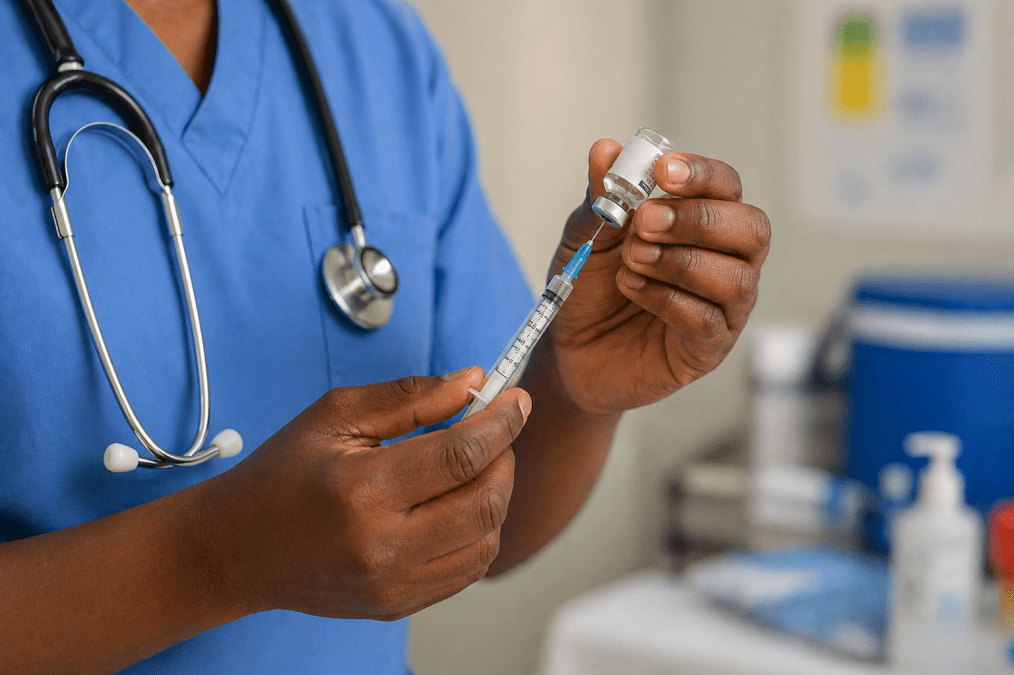
Kenya switched from 10-dose to 5-dose vials of Measles and Rubella vaccine, cutting wastage, improving rural coverage
Even amid the praise, the numbers tell a more sobering story. Between January 2024 and February 2025, Kenya recorded 2,949 measles cases and 18 deaths, a toll tied directly to children slipping through gaps in the national schedule. To close some of these gaps, the country switched in 2025 from 10-dose to 5-dose vials of the Measles and Rubella vaccine, cutting wastage and improving rural coverage.
The vial switch addressed a specific, avoidable problem. Under the old 10-dose system, health workers in rural clinics were often reluctant to open a vial for a handful of children, since unused doses had to be discarded within six hours. Rather than waste nine doses to vaccinate one child, some delayed vaccination altogether, asking families to return later. The smaller vials remove much of that incentive to wait, and officials expect the change to lift coverage where dropout rates are highest.
Beyond the vial fix, the BCU accelerated the building of lasting systems in Kenya: mechanisms to identify, screen, vaccinate and monitor coverage among children aged one to five, alongside training for health workers to catch missed children during routine care, not just emergency campaigns.
WHO Director-General Dr Tedros Ghebreyesus credited this shift to health workers themselves, saying they are “now better equipped to find and vaccinate children missed by routine services.” These are gains Kenya must now build on, without the donor-funded surge that made them possible.
Kenya, now a lower-middle-income country, is gradually exiting Gavi’s accelerated transition support, the arrangement that has long subsidised its vaccines. On April 29, Cabinet Secretary for Health Aden Duale met Gavi representatives and called for digital and structural support to help Kenya sustain its own coverage as that subsidy tapers off.
We caught up with children who missed vaccinations during Covid, but more remain out of reach
Duale said the government currently allocates Ksh4.6 billion annually for vaccine procurement, plus a further Ksh2.6 billion for co-financing obligations with Gavi and other sponsors.
Those figures must grow substantially as Kenya’s share of the bill rises, culminating in full self-financing by 2029/2030. UNICEF Executive Director Catherine Russell struck a note of caution that applies as much to financing as to reach.
“We’ve caught up with some of the children who missed routine vaccinations during the pandemic, but many more remain out of reach,” she said.
Kenyan lawmakers are already pushing to close the gap before it fully opens. Molo MP and National Assembly Budget and Planning Committee Chairperson Kuria Kimani, speaking in March 2026, argued it was time to abandon the notion that vaccination is a donor responsibility. “We must put aside money to vaccinate our children. We can’t say we want our children vaccinated yet we don’t allocate funds for vaccines. If we have money for counties, roads, stadiums and the equalisation fund, we can fund our children’s vaccination,” he said.
Kenya’s national immunisation coverage stands at 80 per cent, according to the 2022 Kenya Demographic Health Survey and the Ministry of Health, meaning roughly 300,000 infants still miss critical vaccines each year against a government target of 1.5 million annually.
Sustaining even that 80 per cent coverage without Gavi’s cushion will require the increased domestic funding Duale and Kimani are now describing. Whether Kenya closes the remaining gap, let alone reaches the 90 per cent target under the Immunisation Agenda 2030, will depend on whether that funding arrives on schedule.