Advertisement
A guide to sunscreen for dark skin tones
06th May, 2026 01:46 PM

If you grew up believing that melanin makes sunscreen optional, you are in good company. It is one of the most persistent myths in skincare, and it tends to travel through families and friend groups like passed-down wisdom. The truth is more complicated and more important than most of us have been told.
Melanin does protect your skin. It absorbs ultraviolet radiation and acts as a partial shield against the sun. One early study found that “five times less UV reaches the upper dermis of Black skin” compared to white skin, a genuine biological advantage.
But less is not the same as none, and that distinction has real consequences.
What the science actually says
A 2024 comprehensive review published in the peer-reviewed journal Cureus put a number to melanin’s protection: darker skin types carry a natural sun protection factor of roughly 13.4, compared to just 3.4 for the fairest skin. That sounds reassuring until you consider that dermatologists recommend a minimum of SPF 30 for daily use. Natural melanin barely gets you halfway there.
The same research flags a harder truth.
While people with dark skin have lower rates of skin cancer, when it does occur, it is often diagnosed at a more advanced stage, leading to poorer outcomes. Less exposure does not mean zero exposure, and the consequences of skipping protection for years quietly accumulate.

There is also the hyperpigmentation conversation. UV rays trigger excess melanin production, which is the root cause of the dark spots and uneven patches that many Kenyans spend a lot of money trying to reverse.
Sunscreen is not just prevention. Used consistently, it is also one of the most effective tools for managing skin tone.
How to pick one that actually works for your skin
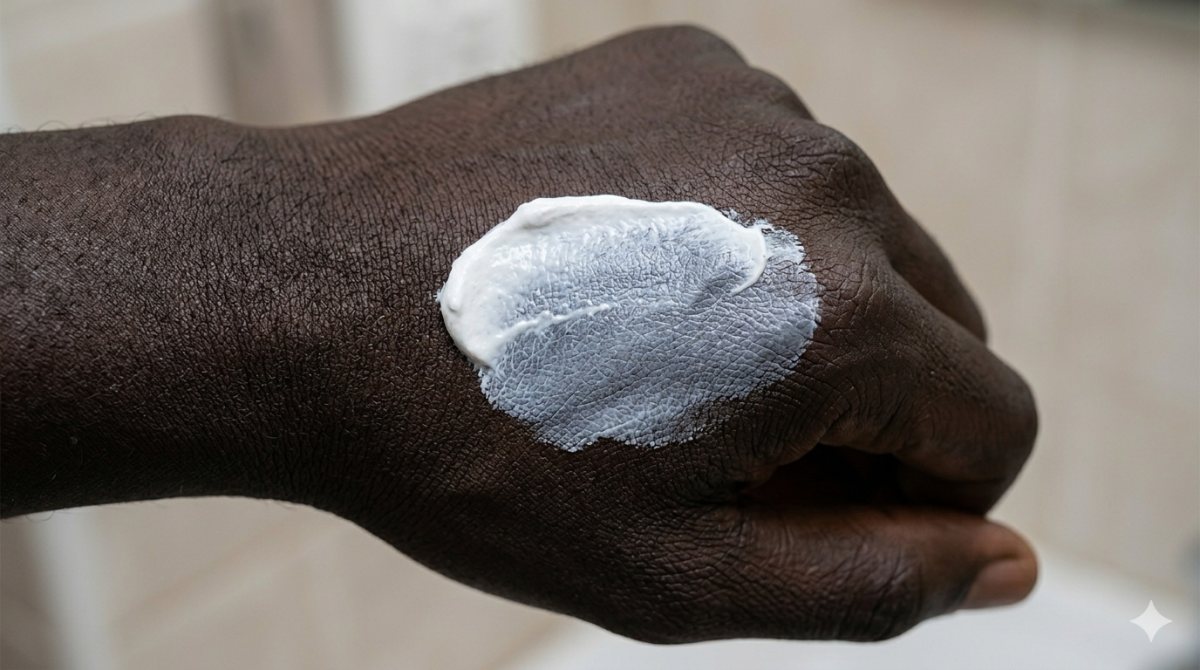
The white cast problem is real, and it is the main reason many people with dark skin reject sunscreen altogether. It happens with mineral sunscreens containing zinc oxide or titanium dioxide, ingredients that reflect light well but sit visibly on darker skin, leaving an ashy or grey film.
Chemical sunscreens absorb UV rather than reflect it and are generally invisible on dark skin. If you prefer mineral options, look for formulas labelled “tinted” or specifically formulated for melanin-rich skin. These are micronised and blended to eliminate the cast.
In either case, look for at least SPF 30 and check that the label says “broad-spectrum”, which means coverage for both UVA and UVB rays. UVA is the one responsible for ageing and pigmentation, and it penetrates through glass and cloud cover, so daily use matters even when you are mostly indoors.
For anyone managing dark spots, a sunscreen that contains niacinamide or vitamin C works alongside UV protection to help fade existing pigmentation over time.
Nairobi sits above 1,700 metres, which means UV intensity here is higher than at sea level. Consistent sun protection is not a luxury but a necessity.