Jane Agatha: GSU officer gains accolades for leading fight against gender violence
By Cynthia Lodite, September 30, 2025Chief Inspector Jane Agatha is a Kenyan police officer who has made it her mission to demand freedom and dignity for women and men living under the shadow of harmful cultural practices and gender-based violence.
In a special report by the National Police Service on Tuesday, September 30, 2025, the NPS has acknowledged her outstanding contribution to the police force, as she has been on her toes, ensuring police officers are also protected from gender-based violence.
Also Watch: Use of technology in curbing FGM
“The National Police Service (NPS) acknowledges and commends CI Jane Agatha Wekesa, HSC, for her unwavering dedication to the fight against FGM, gender-based violence, and other related crimes,” NPS wrote.
The police also added that Agatha, who trained with the General Service Unit in 2011, has brought not only discipline and duty to her work but also a profound sense of purpose.
“Having enlisted in the National Police Service in 2011 and trained with the General Service Unit, CI Wekesa brings not only discipline and duty to her work but also a profound sense of purpose,” NPS said.
According to Jane, she firmly describes how determined she is in ensuring the Police Service and her colleagues are neither victims nor perpetrators of SGBV and femicide.
“There is a way it bites when the person on the other side of the bench is a colleague,” she reflects.
Agatha’s education background
Armed with a Bachelor of Arts in Criminology and Security Studies from Mount Kenya University, she has served in Mariakani, Rabai, Kehancha, ASTU, and Nandi Central, where she secured stringent convictions against perpetrators of FGM and SGBV.
Also Watch: War on FGM : Crusaders demand more gov’t action
She now leads as the Officer Commanding Station (OCS) at Chepterwai Police Station in Nandi County.
Yet, beyond enforcing law and order, her greatest battle lies in dismantling deeply rooted practices such as female genital mutilation (FGM), child marriage, intimate partner violence, and femicide.
“FGM is a regressive culture. It scars the girl and woman in every way—physically, biologically, psychologically, and socially. I will not stop, not today, not tomorrow, until the statistics read zero,” she says.
On her part, ending gender-based violence means protecting everyone—women, men, and children. She urges women to find the courage to walk away from abuse, men to prioritise their mental health over destructive stereotypes, and children to break the silence that often shields abusers within trusted circles.
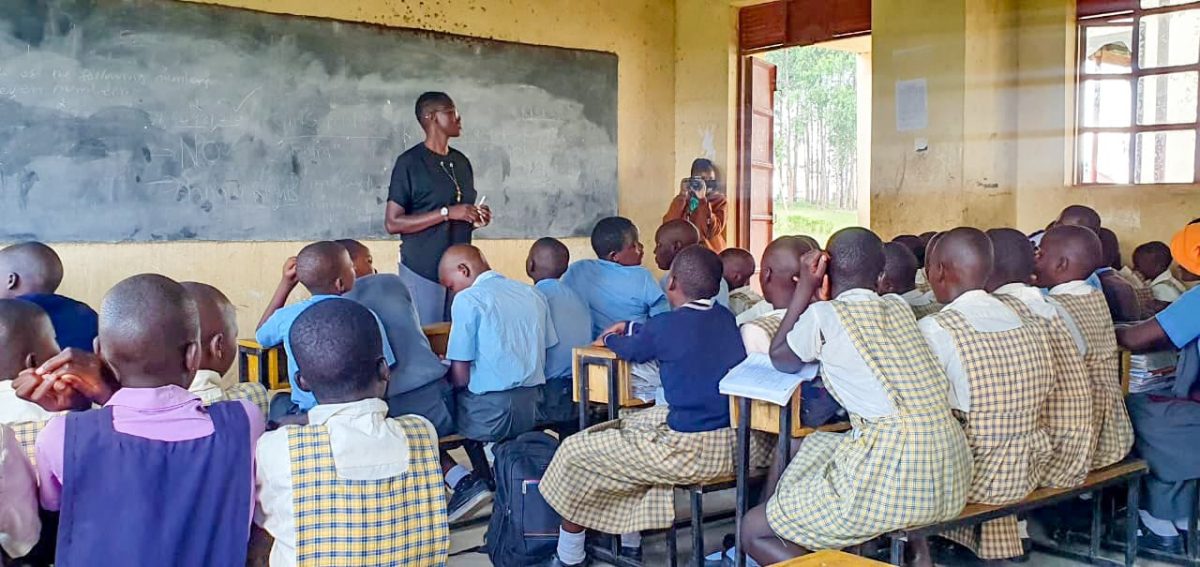
Likewise, she understands that change begins with humility and listening. In her community engagements, she immerses herself at the grassroots level, seeking to understand why some traditions exist before challenging them.
She frames culture as a two-sided coin with harmful practices like FGM and wife-beating on one side and beautiful traditions like child-naming ceremonies on the other.
The medals
Her words are matched by action. Over the years, she has been recognised nationally and internationally for her tireless advocacy. In 2021, Migori County honoured her as an Anti-FGM and SGBV Champion during the 16 Days of Activism.
In 2023, she received a certificate from the then Cabinet Secretary for Gender, Aisha Jumwa, and later that year, she was awarded the Head of State Commendation (HSC) by President William Ruto.
Her impact has also crossed borders; in November 2024, she received a global award from Dr Michael Freeland, founder of Mental-Real-of-State, for her contributions to mental health and resilience in combating social ills.
She is currently researching how different communities perceive FGM and gender-based violence, noting with concern that some still view child marriage as a cultural rather than a crime. Her vision is to extend education to every household under her jurisdiction.
Her leadership philosophy is clear: community empowerment, collaboration, and inclusivity. She insists that the fight against FGM and GBV cannot be won by one person or one agency—it requires the energy of youth, the wisdom of elders, and the cooperation of all stakeholders.
For Jane, policing is not only about enforcing the law but also about shaping a society free from fear, violence, and oppression. At the grassroots, in police stations, and in national decision-making spaces, she stands as a reminder that true service is measured not just by rank or medals, but by the lives transformed through courage, compassion, and commitment.
Her courage and consistency embody the spirit of true service, reminding us that policing extends beyond law enforcement to safeguarding dignity and human rights. The Service also encourages her to continue pursuing her dream of a society free from harmful practices, while acting as a role model to young police officers and inspiring young girls across the country to rise above barriers and become agents of change.