Willis Otieno: Ruto is managing rebellion through violence
By Kenneth Mwenda, July 7, 2025Lawyer and political analyst Willis Otieno has accused President William Ruto’s administration of responding to civic pressure with force, saying the state has moved from leading the nation to managing a rebellion of its own making.
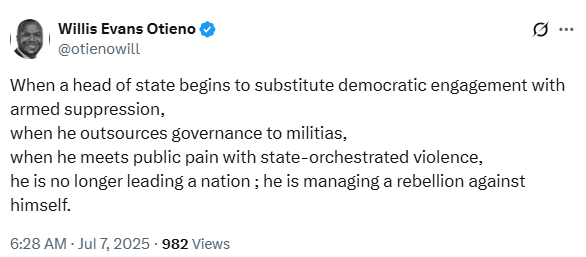
In a powerful statement shared on his official X account on Monday, July 7, 2025, the 35th anniversary of the historic Saba Saba movement, Otieno criticised the government’s approach to public dissent and human rights activism.
“When a head of state begins to substitute democratic engagement with armed suppression, when he outsources governance to militias, when he meets public pain with state-orchestrated violence, he is no longer leading a nation; he is managing a rebellion against himself,” Otieno wrote.
His remarks come against the backdrop of a tense political atmosphere as Kenyans commemorate Saba Saba, a day historically associated with the struggle for multiparty democracy, civil rights, and citizen engagement.
Tensions rise despite calls
While opposition leader Raila Odinga had called for peaceful gatherings at Kamukunji Grounds to honour those who died fighting for political freedoms, there have been scattered reports of police presence and restrictions across the country.
On Sunday,July, 6, 2025, a press conference organised by the Kenya Human Rights Commission (KHRC) at its Nairobi offices was violently disrupted by armed men, drawing sharp condemnation from rights groups and activists. Otieno had earlier criticised the attack, describing it as part of a growing pattern of repression.

Speaking on that incident, Otieno had warned that “what began with disrupting political rallies has now evolved into storming peaceful demonstrations, crashing press conferences, and violently silencing civic engagement.”
This year’s Saba Saba comes at a time when Gen Z-led movements and civil society actors are increasingly vocal about economic justice, digital freedoms, and state accountability. The symbolic date has evolved from its roots in the 1990s, when activists like Kenneth Matiba, Charles Rubia, and Jaramogi Oginga Odinga led calls for multipartyism, into a modern platform for youth-led advocacy and democratic reform.