Willis Otieno: Raila, ODM now co-owners of Ruto’s failures
By Ascah Mwango, August 20, 2025Lawyer Willis Otieno has argued that Raila Odinga and the Orange Democratic Movement (ODM) are increasingly being seen as sharing responsibility for the failures of President William Ruto’s administration.
In a statement shared via his X account on Wednesday, August 20, 2025, Otieno noted that, whether intentional or not, the party has become closely associated with the government’s shortcomings, creating a public perception that Ruto’s political burdens are also theirs.
According to Otieno, this situation places Raila and ODM at a crossroads: either continue aligning themselves with Ruto and risk sinking politically alongside him, or deliberately separate their political path before it becomes too late to salvage their standing.
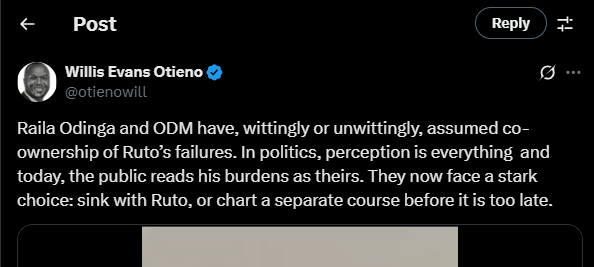
“Raila Odinga and ODM have, wittingly or unwittingly, assumed co-ownership of Ruto’s failures. In politics, perception is everything and today, the public reads his burdens as theirs. They now face a stark choice: sink with Ruto, or chart a separate course before it is too late,” Otieno stated.
His latest remarks add to the growing debate over the evolving relationship between Raila, ODM and President Ruto.
ODM-UDA pact
On March 7, 2025, the ruling United Democratic Alliance (UDA) and ODM signed a cooperation pact aimed at joint consultations on “critical government policies.” The deal drew praise from some leaders who said it could lower political tensions, but also sharp criticism from others who warned it would weaken parliamentary opposition.
State House later said Ruto and Odinga had agreed on a joint framework of cooperation to tackle socio-economic and political challenges framed as consultation rather than power-sharing. Party officials from both sides have since met to discuss how to implement parts of that understanding and to follow through on the National Dialogue Committee (NADCO) agenda.
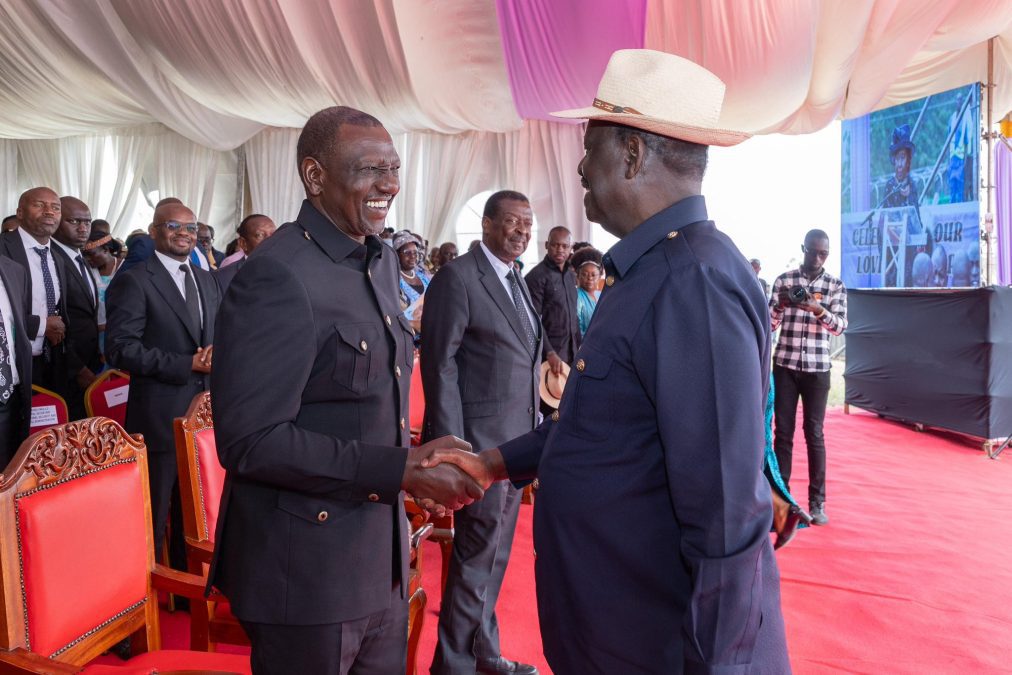
Perhaps the clearest moment of cooperation came when President Ruto publicly backed Raila’s bid for Chairperson of the African Union Commission (AUC), mobilising regional leaders and state resources for the campaign in 2024–2025. Raila’s candidacy was seen as a national project, with the government and opposition figures often appearing on the same platform.
Raila ultimately lost the February 15, 2025, AUC election to Djibouti’s long-serving foreign minister, Mahamoud Ali Youssouf, who was elected during the AU summit in Addis Ababa. The result reshaped domestic politics, with fresh questions about Raila’s next moves and ODM’s posture toward the Ruto administration.
Since the AU race and the March pact, some civil society voices and opposition allies have argued that ODM’s consultations with the government have blurred accountability lines. They point to the slow pace of implementing NADCO recommendations and the optics of joint meetings between ODM and Kenya Kwanza figures. Supporters counter that dialogue delivers reforms faster than street protests and helps stabilise the country.
Both sides have previously stressed that cooperation is issue-based and not a coalition government.