Ruto claps back at British publication on leading Kenya to a dangerous place
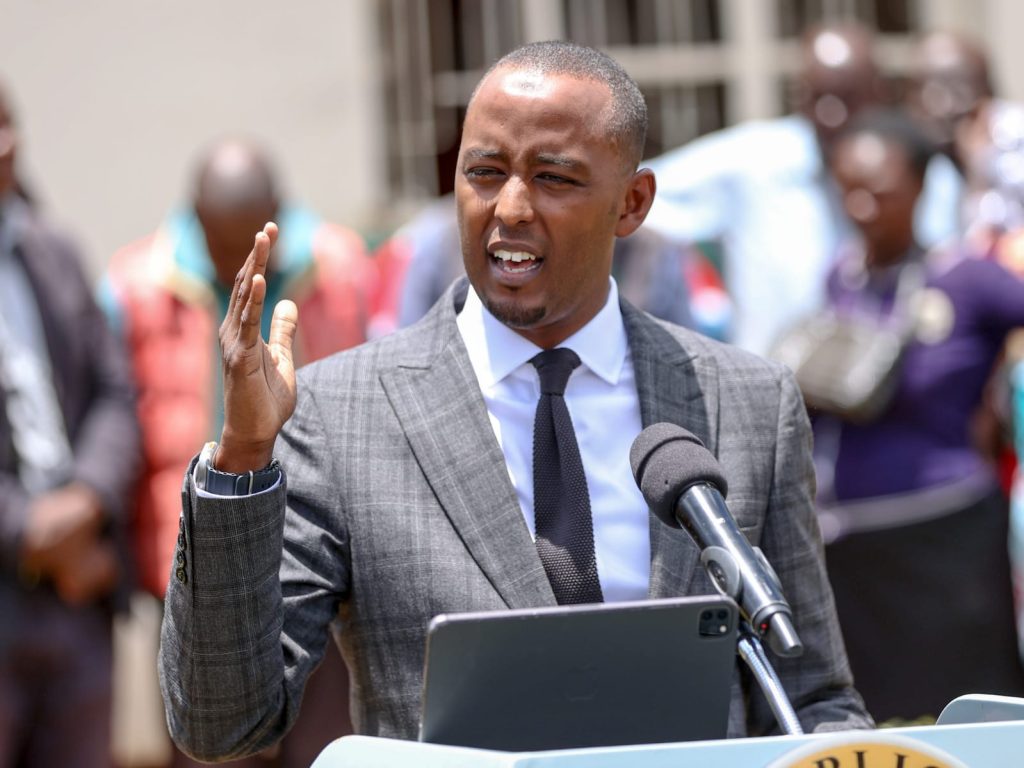
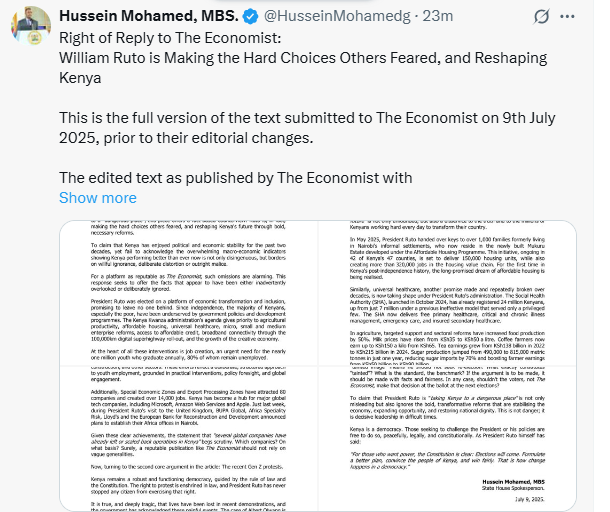
By Aloys Michael, July 18, 2025President William Ruto scoffed at The Economist, a British news journal, after the magazine published a scathing article questioning his leadership and economic direction.
In a statement issued on Friday, July 18, 2025, through State House Spokesperson Hussein Mohamed, Ruto rejected the article’s central claim that Kenya was heading to a dangerous place.
The Head of State dismissed the publication’s analysis as flawed and misleading, saying it ignored Kenya’s strongest economic indicators in two decades.
“This is not dangerous. To claim I’m leading Kenya to a dangerous place is false. We are fixing the roof now, not when the storm comes,” read the statement.
“This is what decisive leadership looks like. It involves tough choices and deep reforms.”
Ignoring facts
Ruto accused the British publication of ignoring key facts about Kenya’s economy. He described the article as either ignorant, distorted, or malicious.
“For a publication as respected as The Economist, such selective reporting is deeply concerning,” he said.
According to the statement, the magazine failed to acknowledge major gains under his administration, especially in economic reforms and social welfare programs.
He highlighted progress in agriculture, universal healthcare, affordable housing, and job creation as central pillars of his agenda.
“These reforms are aimed at lifting millions from poverty and preparing over a million youth for the job market each year,” Ruto explained.
Despite external challenges, including prolonged drought, high global debt, and inflation, Ruto said Kenya’s economy had shown resilience.
He cited several key economic indicators that, he said, reflect Kenya’s resilience under his administration despite global and domestic challenges.
Ruto noted that Kenya’s Gross Domestic Product had grown at an average rate of five per cent since August 2022, showing steady economic progress.
Positive economic outlook
He added that the International Monetary Fund had projected the GDP to reach Ksh17 trillion by 2025, the highest in East Africa.
He also pointed out that inflation had dropped significantly, falling from 9.6 per cent in October 2022 to 3.8 per cent by May 2025.
According to the President, the Kenyan shilling had strengthened by 20 per cent against the US dollar during the same period.
He further observed that the Central Bank Rate had decreased from 13 per cent to 9.75 per cent, helping lower the cost of borrowing.
These shifts, he said, were not accidental but the result of deliberate fiscal and monetary reforms aimed at stabilising Kenya’s economy.
“These numbers don’t lie. They tell the story of an economy on the rise, not in retreat,” he said.
He also dismissed The Economist’s suggestion that global companies were leaving Kenya.
“Which companies? On what grounds? A credible publication should not rely on vague claims,” he posed.
Ruto named several international firms expanding operations in Kenya, including Microsoft, Apple, Amazon Web Services, and BUPA Global.
He noted that over 14,000 jobs had been created through Export Processing and Special Economic Zones.
In recent Gen Z-led protests, Ruto acknowledged the public unrest and confirmed investigations were ongoing into police conduct.
He specifically mentioned the killing of 22-year-old protester Albert Ojwang, calling it “a tragic and regrettable incident.”
“We do not take this lightly. Officers involved are being held accountable,” Ruto stated.
Protest effects and economy
He reaffirmed that Kenya remains a democracy where peaceful protest is protected. However, he urged demonstrators to remain non-violent.
“Rights must be balanced. Protests must not infringe on the freedoms of others,” he added.
Ruto also defended his decision to withdraw the Finance Bill 2024, saying it showed his administration listens to the people.
“We paused, listened, and responded. That is the essence of responsible governance,” he said.
The President also addressed the article’s claim that current protests are unique because they lack ethnic divisions.
He pushed back, saying civic activism in Kenya has rarely been organised along tribal lines in recent years.
“Why inject ethnic undertones into what is an issue-based movement? It’s unnecessary and damaging,” he said.

The article’s closing suggestion that Ruto’s “tainted image” disqualifies him from re-election also drew criticism from the President.
“What does ‘tainted’ even mean? Who defines it? And shouldn’t the people of Kenya decide that at the ballot box?” he asked.
Ruto framed his administration as one willing to confront hard, long-ignored issues head-on, regardless of political cost.
“For those who want power, elections are coming. Build a better plan, convince the people, and win fairly. That’s democracy.”