Raila Jr questions plan to give bursaries to parents instead of schools
By Nancy Marende, August 20, 2025Raila Odinga Jr, the son of the Orange Democratic Movement (ODM) party leader, has questioned the government’s approach to bursary allocations.
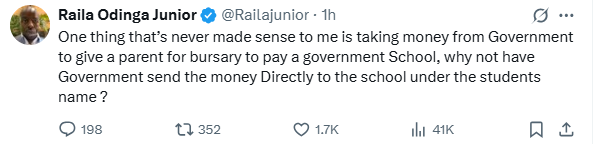
In a statement on Wednesday, August 20, 2025, Odinga wondered why money is given directly to parents instead of being sent to schools under the student’s name.
“One thing that’s never made sense to me is taking money from the government to give a parent a bursary to pay for a government school. Why not have the government send the money directly to the school under the student’s name?” he posed.
NG-CDF
This comes after the Auditor-General Nancy Gathungu’s report for the year ending June 2024 revealed that at least Ksh4.1 billion meant for student bursaries through the National Government Constituency Development Fund (NG-CDF) cannot be traced, raising serious questions over how MPs have managed the fund.
The report showed that while 125 constituencies reported helping thousands of students, most could not provide the necessary documentation to support their claims.
The audit revealed that 86 constituencies failed to present records for Ksh2.12 billion, including receipts from schools, acknowledgement forms from students, and admission numbers.
“Eighty-six NG-CDF (offices) failed to provide supporting documents for bursary disbursements, including acknowledgements, receipts from beneficiary institutions, and details of students’ admission numbers, amounting to Ksh2,122,652,960,” Gathungu said.
An additional 39 constituencies could not account for Ksh1.97 billion. They lacked documents showing how bursary applications were vetted, such as committee minutes, policy guidelines, or assessment reports.
“Bursary disbursements amounting to Ksh1,971,099,695 in respect to 39 NGCDFs were not supported with documentation on vetting of applications, including bursary vetting committee minutes/reports and policy and/or guidelines on bursary awards, leading to potential bias and exclusion of deserving students,” the Auditor-General noted.
The NG-CDF, introduced in 2003 by President Mwai Kibaki, has long been used by MPs to fund classroom construction, police stations, and bursary awards.
MPs have defended the fund as vital support for needy students, but the audit’s findings highlight lapses in accountability just as the fund is set to close.
A High Court ruling last year declared the NG-CDF unconstitutional and ordered it to stop operating by June 30, 2026.
“The NG-CDF and all its programmes, projects and activities shall cease to operate at the stroke of midnight on June 30, 2026,” the court ruled in September last year.