Otieno points to rising political awareness in Kenya amid SHA storm
By Ascah Mwango, August 26, 2025Lawyer and political commentator Willis Otieno has cautioned that Kenyans are no longer passive in the face of corruption scandals as the Social Health Authority (SHA) finds itself at the centre of a storm.
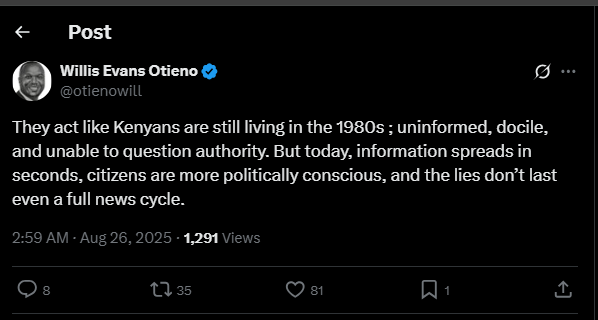
In a statement shared on his X account on Tuesday, August 26, 2025, Otieno criticised leaders and institutions that still operate under the assumption that citizens can be easily deceived or pacified.
He argued that, unlike in previous decades when Kenyans were less informed and hesitant to challenge authority, today’s environment is marked by instant access to information, robust public discourse, and a vigilant citizenry that questions official narratives.
According to him, misinformation and political spin no longer hold sway for long, as Kenyans increasingly demand transparency and answers from those in power.
This shift, he suggested, has made it harder for scandals to be swept under the rug.
“They act like Kenyans are still living in the 1980s; uninformed, docile, and unable to question authority. But today, information spreads in seconds, citizens are more politically conscious, and the lies don’t last even a full news cycle,” he stated.
Non-compliant medical claims
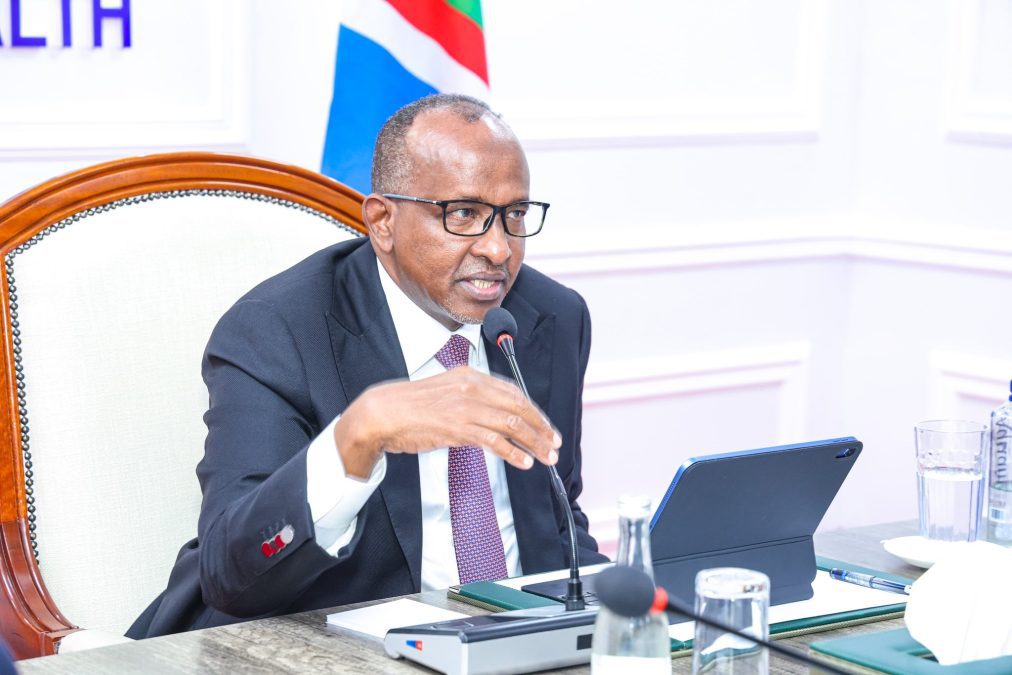
Otieno’s remarks come shortly after the Ministry of Health announced that it had rejected fraudulent and non-compliant medical claims amounting to Ksh10.6 billion. Health Cabinet Secretary Aden Duale described the move as a major step in the government’s anti-fraud campaign within the national health sector.
In a press release shared on the ministry’s X account on Monday, August 25, 2025, Duale reaffirmed the government’s commitment to protecting public resources under the TaifaCare universal health coverage program.
“These claims were found to violate Section 48(5) of the Social Health Insurance Act, 2023, which outlines penalties for providers who knowingly or fraudulently alter information to defraud the Authority. Our position on safeguarding public resources has been consistent, clear, and unwavering. Fraud has no place in our health sector,” he said.
The crackdown comes as part of a wider effort to strengthen transparency in the Social Health Insurance Fund (SHIF), the key pillar of TaifaCare, which was launched on October 1, 2024. The program was designed to guarantee every Kenyan access to affordable healthcare.
According to ministry data, health facilities have so far submitted claims worth Ksh82.7 billion. Of this, Ksh53 billion has been paid out, while Ksh6.4 billion has been approved and is awaiting payment.
Claims worth Ksh7.6 billion from August are under review. Besides the Ksh10.6 billion already rejected, Ksh3 billion in claims are being re-evaluated due to missing documents, while another Ksh2 billion has been flagged for surveillance.
Duale explained that this process was critical to safeguarding taxpayer money.
“Every shilling contributed to the Social Health Insurance Fund must go towards legitimate, life-saving healthcare,” he said.
The revelations have heightened public anger as suspicions grow that billions of shillings meant for healthcare have been siphoned off through fraudulent claims and fictitious hospitals.
SHA was created to replace the scandal-ridden National Health Insurance Fund (NHIF), which was dissolved after years of mismanagement. However, similar allegations of corruption have already begun to dog the new authority.
SHA crisis
In March 2025, SHA disbursed Ksh11.4 billion to hospitals across the country. Questions quickly arose after small private facilities were found to have received disproportionately large amounts. Civil society groups and doctors’ unions warned that some of these hospitals did not exist, while others had exaggerated claims.
The ministry has since launched investigations. Duale revealed that inspectors uncovered falsified patient records, duplicate claims, ghost patients, and cases where hospitals inflated bed capacity to pocket millions. In one instance, investigators discovered that funds had been released to a supposed hospital that was nothing more than a thicket.
On August 7, 2025, a Kenya Gazette notice listed 40 hospitals suspended from the SHA program following a forensic audit. Twelve doctors and clinicians were also blocked for their alleged involvement in fraudulent activities.
SHA has dismissed some reports, including claims that Nyandiwa Hospital had received Ksh20 million. The authority insisted the allegations were false, but the denials have done little to calm public outrage.
Oversight institutions have also raised red flags. Earlier this year, the Auditor General faulted the procurement of SHA’s digital platform, citing weak controls and irregular tendering processes. Civil society groups have echoed these concerns, saying the lack of competitive bidding created loopholes ripe for exploitation.
The scandal has drawn comparisons to the NHIF, which a court ruled in May 2025 had suffered years of fraud through ghost patients, inflated claims, and unpaid bills that crippled many hospitals.