Kenya Met lists areas at high malaria risk following unusual rainfall
By Steve Ireri, November 5, 2025The Kenya Meteorological Department has released a detailed malaria epidemic early prediction bulletin for the western highlands of Kenya, covering Kakamega, Kisii, and Nandi counties, for the period November to December 2025.
The report, issued on Wednesday, November 5, 2025, is a collaborative effort between Kenya Met, the Kenya Medical Research Institute, and the Ministry of Health.
Also watch: Kenya Met warns of heavy rains and scorching heat
According to Kenya Met, the forecast is based on observed climate data, including maximum and minimum temperatures, rainfall anomalies, and model simulations that estimate the percentage risk of malaria transmission.
“This report presents the malaria epidemic early prediction model outputs for the Western Highlands of Kenya, covering Kakamega, Kisii, and Nandi, for the period November to December 2025,” Kenya Met wrote.
In Kakamega, the bulletin indicates a high risk of a malaria epidemic.
The area experienced a slight increase in maximum temperature from 28.1°C in September to 27.0°C in October, 2025, and rainfall rose sharply from 105.8mm to 248.7mm over the same period.
The combined effect of above-average rainfall and warm temperatures creates conditions favourable for mosquito breeding, which Kenya Met says has pushed the additive model percentage risk to 36.4 per cent, exceeding the epidemic threshold of 30 per cent.
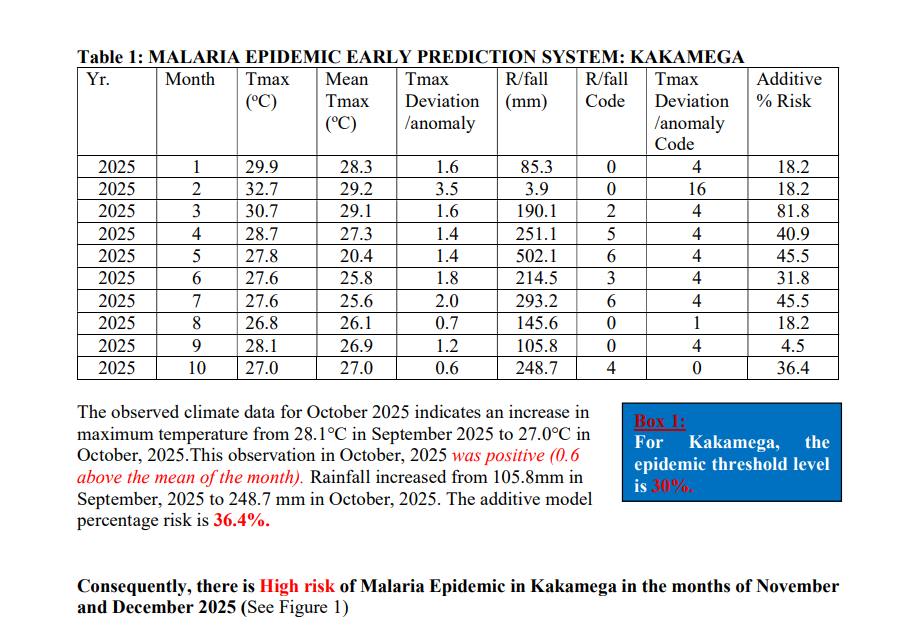
November 2025. PHOTO/Screengrab by K24 Digital.
In Kisii, the forecast shows no immediate risk of malaria outbreaks for November and December.
Observed climate data indicate a slight decrease in maximum temperature from 26.2°C in September to 25.6°C in October, with rainfall increasing from 255.5mm to 301.6mm.
Despite the rainfall increase, Kenya Met’s model predicts negligible epidemic risk, well below Kisii’s 20 per cent threshold.
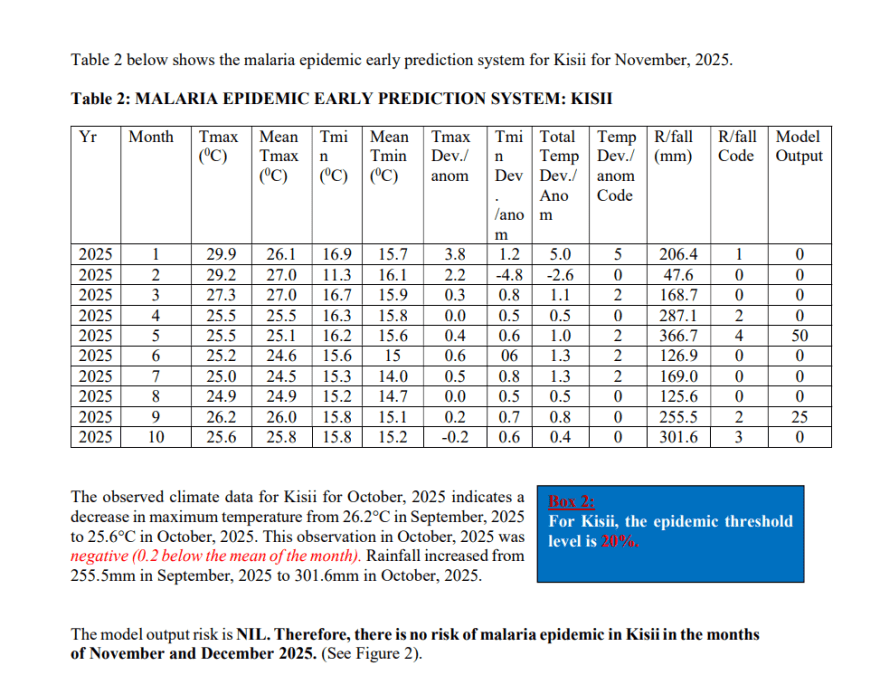
November 2025. PHOTO/Screengrab by K24 Digital.
Similarly, in Nandi, there is no significant malaria risk projected.
Temperatures fell slightly from 24.0°C in September to 23.0°C in October, while rainfall rose from 170.3mm to 238.1mm.
The resulting additive model percentage risk is only 5 per cent, far below the 20 per cent epidemic threshold established for the county.
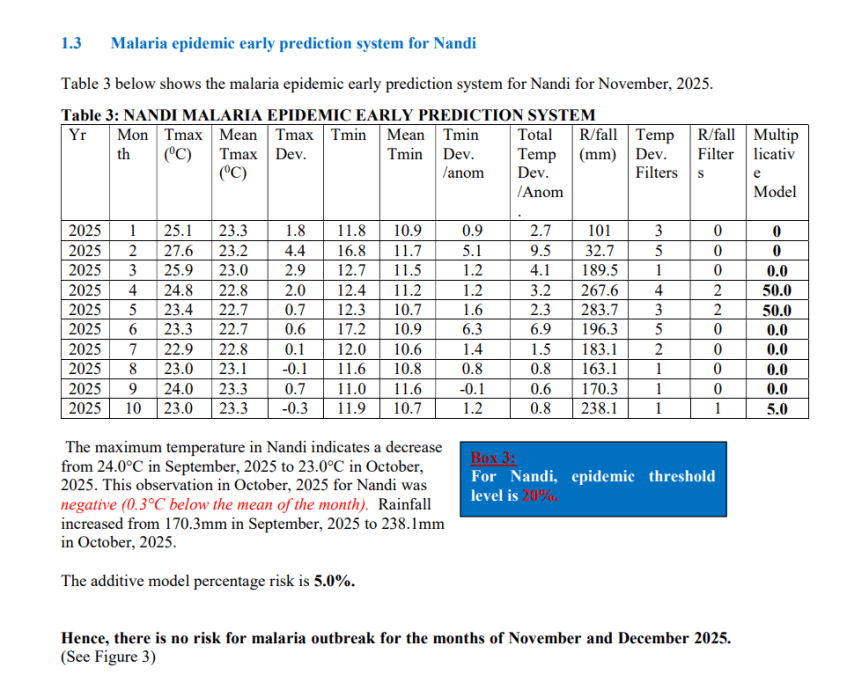
November 2025. PHOTO/Screengrab by K24 Digital.
Kenya Met emphasised that the forecast is based on predictive models and observed climate trends, both of which are subject to change.
Also watch: Sunny intervals, strong winds expected in parts of Kenya — Kenya MET
The department urged local health authorities to remain vigilant, continue monitoring mosquito activity, and implement preventive interventions, particularly in areas identified as high risk.
“The information presented in this bulletin is based on predictive models and observed climate data, which are subject to change. While every effort has been made to ensure the accuracy and reliability of the data, the following should be noted,” the department shared.
Kenya Met further advised that this information is for guidance purposes only and should not be the sole basis for public health decisions.
They added that continuous monitoring and updated data remain essential for accurate malaria risk assessment and timely action.
“This bulletin is intended for informational purposes only. It should not be used as the sole basis for public health decisions. Local health authorities should be consulted for actionable guidance and preventive measures against malaria,” Kenya Met wrote.